Factsheet 19: CCAM – Conformal Cubic Atmospheric Model
What is CCAM?
The Queensland Future Climate Science Team has been using CCAM (Conformal Cubic Atmospheric Model), a climate model developed by CSIRO, to dynamically downscale global climate models (GCMs), to produce high resolution (10 km) regional climate projections. The team has downscaled the two latest generations of GCMs (i.e., CMIP5 and CMIP6). Dynamical downscaling is the process of running a climate model to improve the resolution of a coarse resolution model, such as a GCM. CCAM is an open-source climate model and its full scientific description of dynamical, physical and chemical components (Figure 1) is available online.
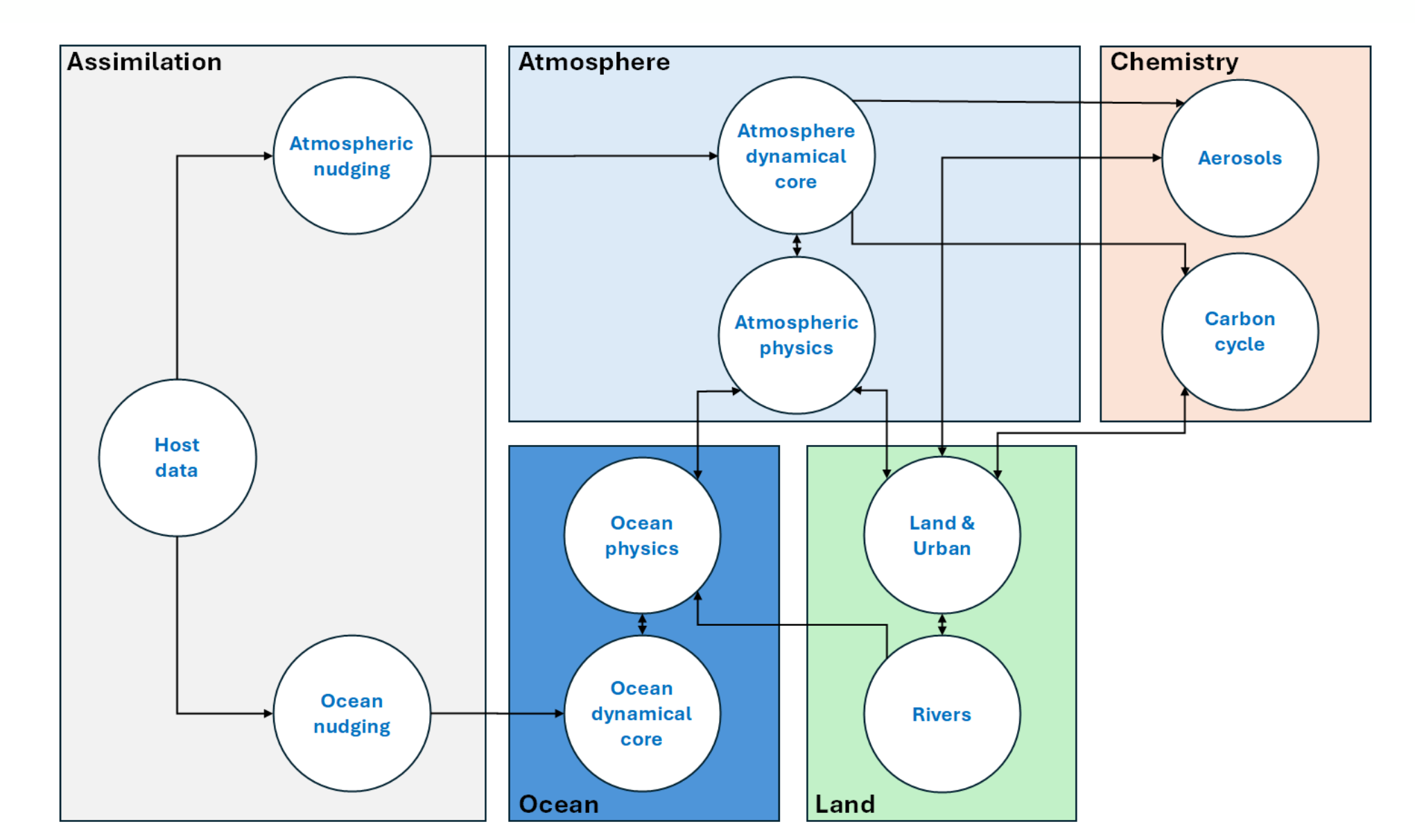
Dynamical downscaling is often accomplished using a regional climate model – a climate model that runs for a limited region, for example, Australia, at a high resolution. However, variable resolution global climate models, such as CCAM, can also be used to dynamically downscale. This approach avoids the use of boundary conditions and their associated errors, while reducing the dependence of results on the size of the domain.
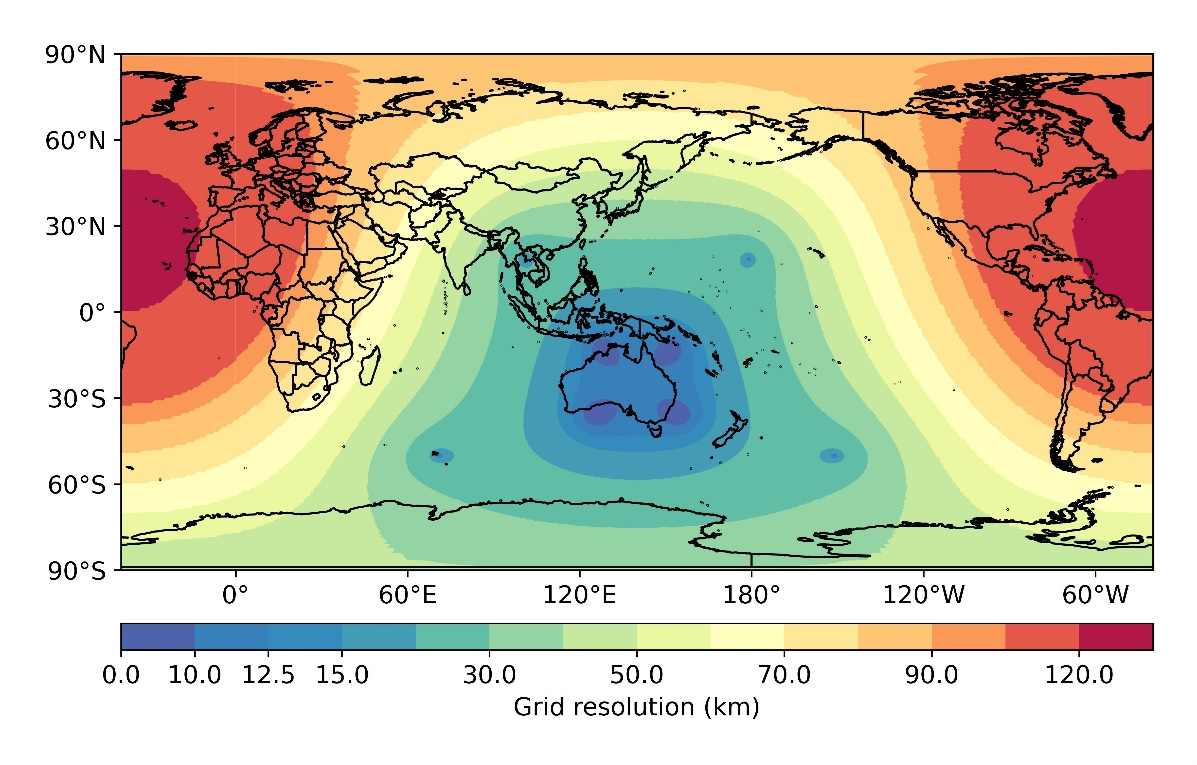
CCAM has been developed as a global variable resolution model and can be used as stand-alone climate model and in downscaling. CCAM has a stretched grid (Figure 2), and over an area of interest, such as Australia, it runs at a high resolution (Figure 3).

CCAM model setup
The Queensland Future Climate Science Team has completed a comprehensive set of downscaled simulations for the Australasian domain following the CORDEX-CMIP6 experimental protocol using CCAM. CORDEX is an international downscaling experiment, similar to the CMIP6 experiment but for regional models. Participating in CORDEX allows our models to be used by researchers in Australia and internationally, and for our models to be compared to others available, which is vital to improve model performance, and to make sure we are using the best available science for Queensland.
We ran CCAM in atmosphere-only and ocean-coupled mode. Ocean-coupled mode means we used the ocean model in CCAM, and allowed interactions between the atmosphere and ocean. Atmosphere-only mode does not use the ocean model, and the only information from the ocean is the bias-corrected sea surface temperatures (SSTs) from the host model (GCM that is being downscaled). There are pros and cons to both modes – using the atmosphere-only bias corrected SSTs can reduce some biases from the ocean model, however interactions between the atmosphere and ocean are also important for things like tropical cyclones and ENSO. Using both modes allows us to get the benefit from both, and better understand the strengths and weaknesses of the model for Queensland, and improve future performance.
We ran CCAM used a stretched C288 grid, with approximately a 10km resolution over Australia (Figure 3). CCAM is a stretched grid model, so while we ran at a 10km resolution over Australia, the rest of the globe had a different resolution, defined by the C288 grid, as shown in Figure 3.
A climate model runs for the atmosphere as well as the surface of the earth. The model can be ran with different vertical levels in the atmosphere. We ran CCAM with 35 vertical levels in the atmosphere, and for the ocean-coupled models, 30 levels in the ocean.
CCAM was forced using the CMIP6 radiative forcings for the historical period and future climate change scenarios (SSPs) and by the bias-corrected sea surface temperatures (SSTs) and sea ice from the host CMIP6 GCMs. Radiative forcings include solar radiation, natural and anthropogenic aerosols, transient land use, ozone and greenhouse gases. For the atmosphere-only models, CCAM was run using bias-corrected SSTs. Bias correcting SSTs prior to downscaling has been found to improve model performance for temperature and precipitation biases. We also ran some models in ocean-coupled mode. For those models, spectral nudging was applied to bias-corrected SSTs from the host model over the ocean domain. Often, GCMs are downscaled using limited-area models. In these cases, information from the GCM comes into the high-resolution model every 3 – 6 hours at the boundary. CCAM however is a stretched grid model, and runs for the entire globe. The information from the host GCM comes into CCAM via spectral nudging which constrains CCAM to follow the host GCM at large scales, but allows the small scales to evolve freely. See Table 1 for a list of downscaled models, and whether they were run in atmosphere-only or ocean-coupled mode.
Table 1: CMIP6 GCMs and ensemble members selected for downscaling. Latitude and longitude grid size shown in resolution column. GCMs were downscaled using different CCAM configurations – atmospheric model only or atmosphere-ocean coupled.
| CMIP6 Model | Model full name | Resolution | Ensemble member | CCAM configuration |
|---|---|---|---|---|
| ACCESS-ESM1.5 | Australian Community Climate and Earth System Simulator, version 1.5 | 1.875 x 1.25° |
r6i1p1f1 |
atmospheric |
ACCESS_CM2_oc |
Australian Community Climate and Earth System Simulator, version 2 |
1.875 x 1.25° |
r2i1p1f1 |
atm-ocean coupled |
CMCC-ESM2 |
Centro Euro-Mediterraneo sui Cambiamenti Climatici Earth System Model, version 2 |
0.9 x 1.25° |
r1i1p1f1 |
atmospheric |
CNRM-CM6-1-HR |
Centre National de Recherches Météorologiques Coupled Global Climate Model, version 6.1, high-resolution |
0.5 x 0.5° |
r1i1p1f2 |
atmospheric |
EC-Earth3 |
European Community Earth-System Model, version 3 |
0.8 x 0.8° |
r1i1p1f1 |
atmospheric |
FGOALS-g3 |
Flexible Global Ocean-Atmosphere-Land System Model, grid point version 3 |
2.5 x 2.5° |
r4i1p1f1 |
atmospheric |
GFDL-ESM2M |
Geophysical Fluid Dynamics Laboratory Earth System Model, version 4 |
1 x 1° |
r1i1p1f1 |
atmospheric |
GISS-E2-2-G |
Goddard Institute for Space Studies Model E2.2G |
2. x 2.5° |
r2i1p1f2 |
atmospheric |
MPI-ESM1-2-LR |
Max Planck Institute Earth System Model, version 1.2, low resolution |
1.9 x 1.9° |
r9i1p1f1 |
atmospheric |
MRI-ESM2-0 |
Meteorological Research Institute Earth System Model, version 2.0 |
1.125 x 1.125° |
r1i1p1f1 |
atmospheric |
NorESM1-MM |
Norwegian Earth System Model, version 2, 1 degree resolution |
1 x 1° |
r1i1p1f1 |
atmospheric |
Data from the simulations is available in gridded netCDF format on NCI. This data also forms the basis of the Queensland Future Climate Dashboard, and data can be downloaded from there in csv format.
CCAM land surface model
We ran CCAM with the CABLE (Community Atmosphere Biosphere Land Exchange) land surface model. CABLE supports vegetation tiles, changing land-use and a carbon cycle, enabling representation of landscape heterogeneity within grid cells.
Using the CMIP6 land use change scenarios has caused some small artifacts in some areas of Queensland, which are most obvious when looking at 10-meter wind speed. In some areas the height of the vegetation has increased, which has caused wind speeds to slow down. This has minimal effect on indices other than wind speed and evaporation.
Further information
Further details on CCAM are available in:
Chapman et al., 2023: Evaluation of Dynamically Downscaled
CMIP6-CCAM Models Over Australia,
Schroeter et al., A Comprehensive Evaluation of Mean and Extreme
Climate for the Conformal Cubic Atmospheric Model (CCAM)
and
Conformal Cubic Atmospheric Model (csiro.au).
